
AQUACULTURE
Microbial formulations for fish and shrimp
We supply microbial formulations for fish and shrimp farms. Some are intended for feed, others for pond water or sediment. We begin by asking which part of your system needs attention.
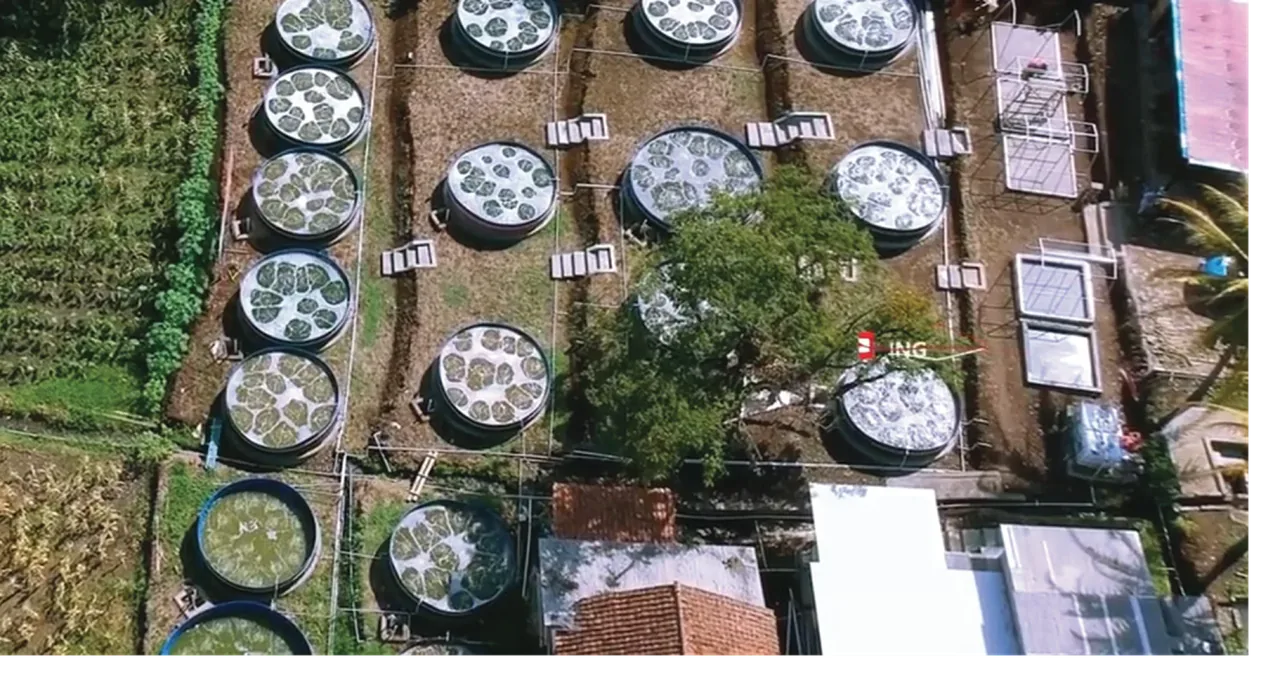
FISH & SHRIMP BIOSOLUTIONS
Pond water, feed and microbial management
Pond ecology
Uneaten feed and other organic matter become part of the pond environment. We can study microbial formulations for organic matter management and nutrient cycling.
Growth and feed use
For a feed product, we look at the species and feeding programme and agree which measures will help assess digestion or nutrient use.
Microbial management
Water-quality and microbial records are useful starting points when pond conditions change. Tell us what you have seen and how the pond is usually managed.
AQUACULTURE BIOSOLUTIONS
Product options and formulation development
Stocking conditions, production intensity and water quality vary between systems. Those differences matter when choosing a product to evaluate.
Microbial formulation
Our generic options include individual microorganisms and mixtures. We can also develop a formulation around a specific feed or water application.
Integrated water management
We study water bioremediation formulations in the context of a farm’s existing management of organic matter and nutrients.
Precision Aquaculture Probiotics · Precision Water Bioremediation Microbes · Precision Enzymes · Precision Toxin Binder
SELECTED MICROBIAL OPTIONS
Microbial options for aquatic systems
| Microorganism / formulation | Application focus | Format |
|---|---|---|
| Nitrifying bacteria: Nitrosomonas spp. + Nitrobacter spp. | Water quality | Liquid |
| Rhodobacter sphaeroides | Water quality | Liquid |
| Aquaculture probiotic consortium | A combination of microorganisms for the intended aquatic application | Liquid |
Ask us about the available consortium, product specification and minimum order quantity for your species and use.
FIELD RESULTS / PAHANG SHRIMP PROGRAMME
Probiotic screening and pond monitoring in Pahang
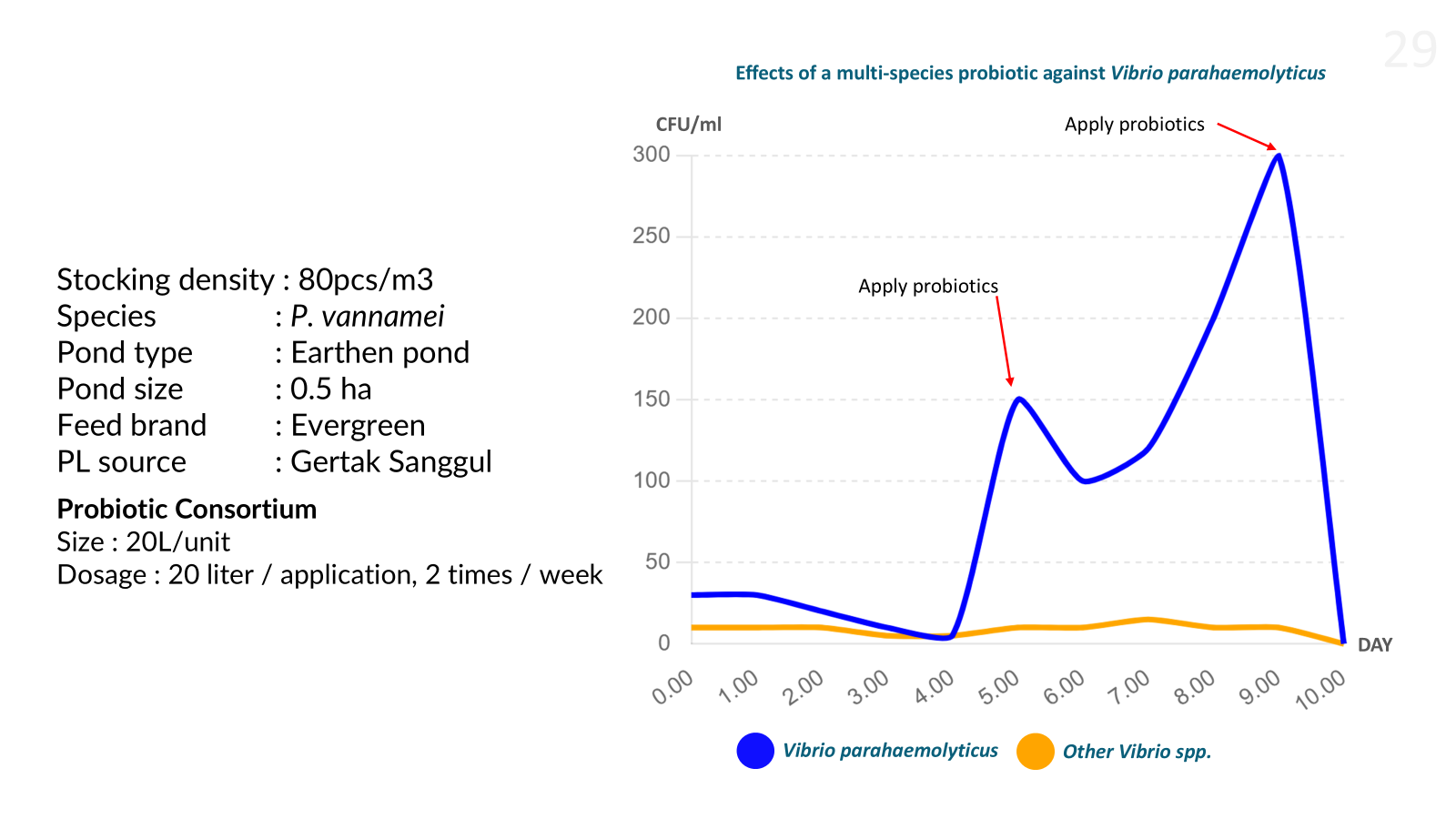
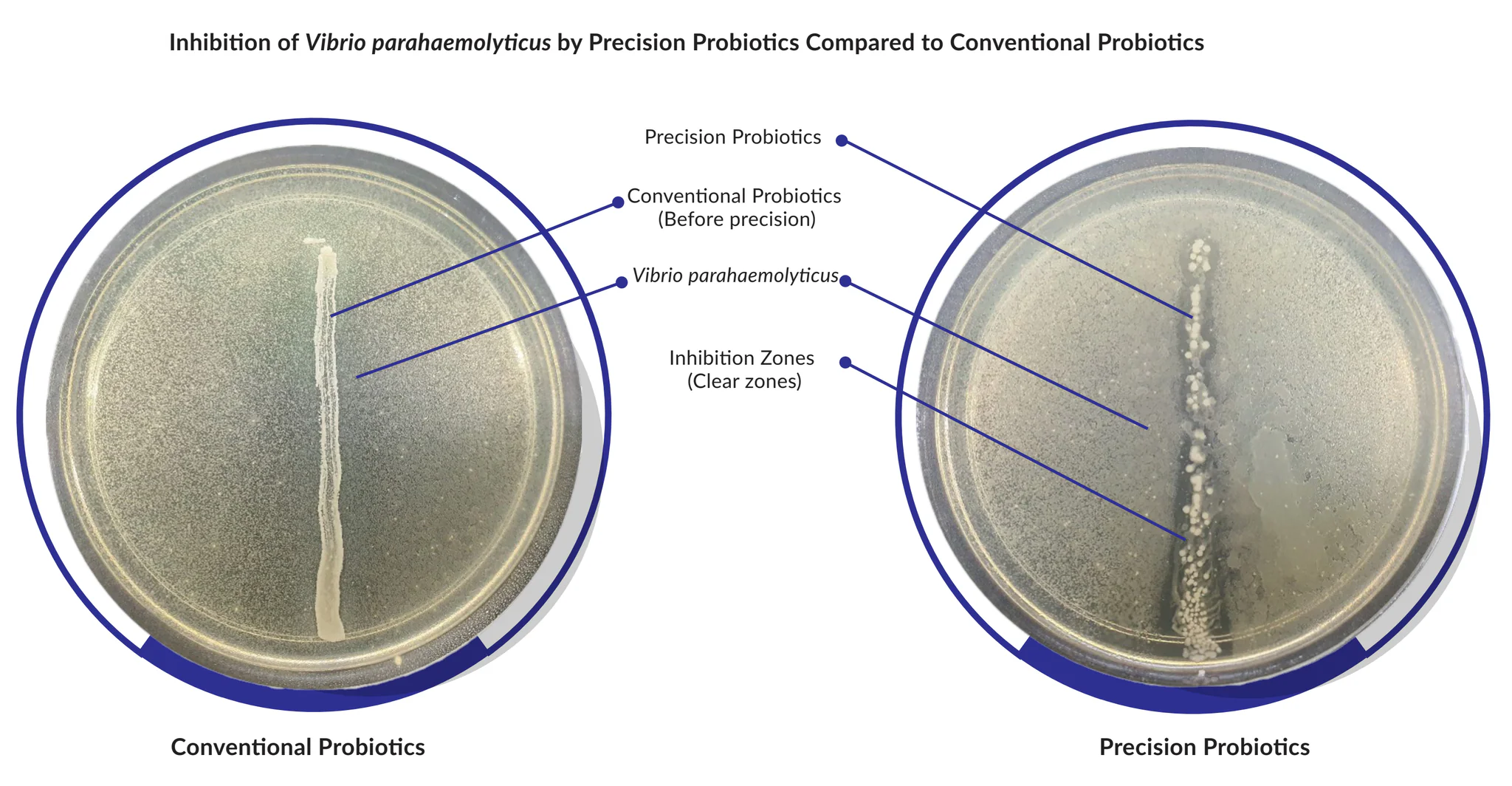
A customised programme for P. vannamei in a 0.5-hectare earthen pond connected laboratory screening with pond-water Vibrio monitoring.
The production setting
Species: P. vannamei
Pond type: earthen pond
Pond area: 0.5 hectare
Reported stocking density: 80 animals/m³
The programme used a probiotic consortium and tracked water Vibrio counts around marked applications.
Study application: 20 litres per application, twice weekly. This rate describes the study programme; formulation and application guidance are agreed for each farm.
What was evaluated
Laboratory images compare inhibition of Vibrio parahaemolyticus by conventional and precision probiotics. The water-monitoring chart records changes in Vibrio counts over the observation period.
These laboratory and monitoring observations do not establish a measured harvest improvement for this programme.
PLAN YOUR AQUACULTURE ENQUIRY
Tell us about your aquatic system
Species and system
Include the species and production stage, pond or tank size, and stocking conditions.
What has changed?
Share recent water readings or microbial observations, how you manage the system and what you would like to investigate.
SUSTAINABILITY IN PRACTICE
Organic matter and nutrient cycling
How organic matter breaks down and nutrients move through the pond matters to the long-term condition of the water.
START WITH YOUR OPERATION
Discuss a fish or shrimp application
Tell us whether your question is about feed, water or sediment. A recent reading or a description of a change on the farm can help us decide where to begin.